
Most marketing teams say they have a brand voice. Few actually do. They have three adjectives in a Notion doc, a tone preference for the homepage and a vague sense that their content should sound consistent. Then a freelancer writes a blog post that sounds like a different company, and nobody notices until a customer points it out.
This guide covers what brand voice is and how it differs from tone and style. It also covers what working brand voice guidelines must contain and how to enforce them with AI in 2026. By the end, you will have a framework you can apply to your own content this quarter. You will also have the criteria to choose a tool that scales the work as your team grows.
What is brand voice?
Brand voice is the consistent personality your brand expresses in writing across every channel and contributor. It is the throughline that makes a tweet, a sales email, a product release note and a help center article all sound like they came from the same company.
The mistake most marketing teams make is to treat brand voice as a synonym for "marketing copy" or "messaging." It is neither. Messaging covers what you say, the value props and positioning. Marketing copy is one channel where voice shows up. Brand voice is the underlying personality, the way you sound, that holds across every output regardless of who wrote it.
A useful test: if you removed your logo and product name from a piece of content, would a reader still recognize you? If yes, you have a brand voice. If the same content could plausibly come from any of three competitors, you do not.
Strong brand voice is also durable. The product evolves. The audience grows. Channels come and go. Voice persists across all of it, which is what makes it a long-term asset rather than a campaign artifact.
Voice, tone and style
Most marketing teams use voice, tone and style as if they mean the same thing. They do not, and the distinction is what separates teams who can scale brand consistency from teams who cannot.
Voice is constant. It is who you are as a brand expressed in writing. A scrappy challenger brand that sounds direct and irreverent has that personality whether the content is a homepage hero or a 404 page.
Tone shifts with context. Tone is the situational variation of voice. The same brand voice can be celebratory in a launch announcement, careful in a security incident update and patient in a help center article. Voice does not change. Tone modulates around it.
Style is mechanical. Style is the rule layer underneath both. Oxford comma or not. Sentence case headings or title case. Whether "sign up" is the verb and "signup" is the noun. Style rules are the things a copy editor flags. They support voice and tone but are separate from them.
A simple table to keep these straight:
Layer | What it controls | When it changes |
|---|---|---|
Voice | Personality, perspective, attitude | Almost never |
Tone | Emotional register for context | Often, by channel and situation |
Style | Mechanical rules and formatting | Rarely, when reviewed |
The reason this matters: if your voice doc only addresses tone words ("we are friendly, professional and helpful"), you have not actually defined a voice. You have defined a tone preference for one situation. Strong brand voice work specifies all three layers and makes their relationship explicit, which is what gives writers real guidance instead of vague adjectives.
The five components
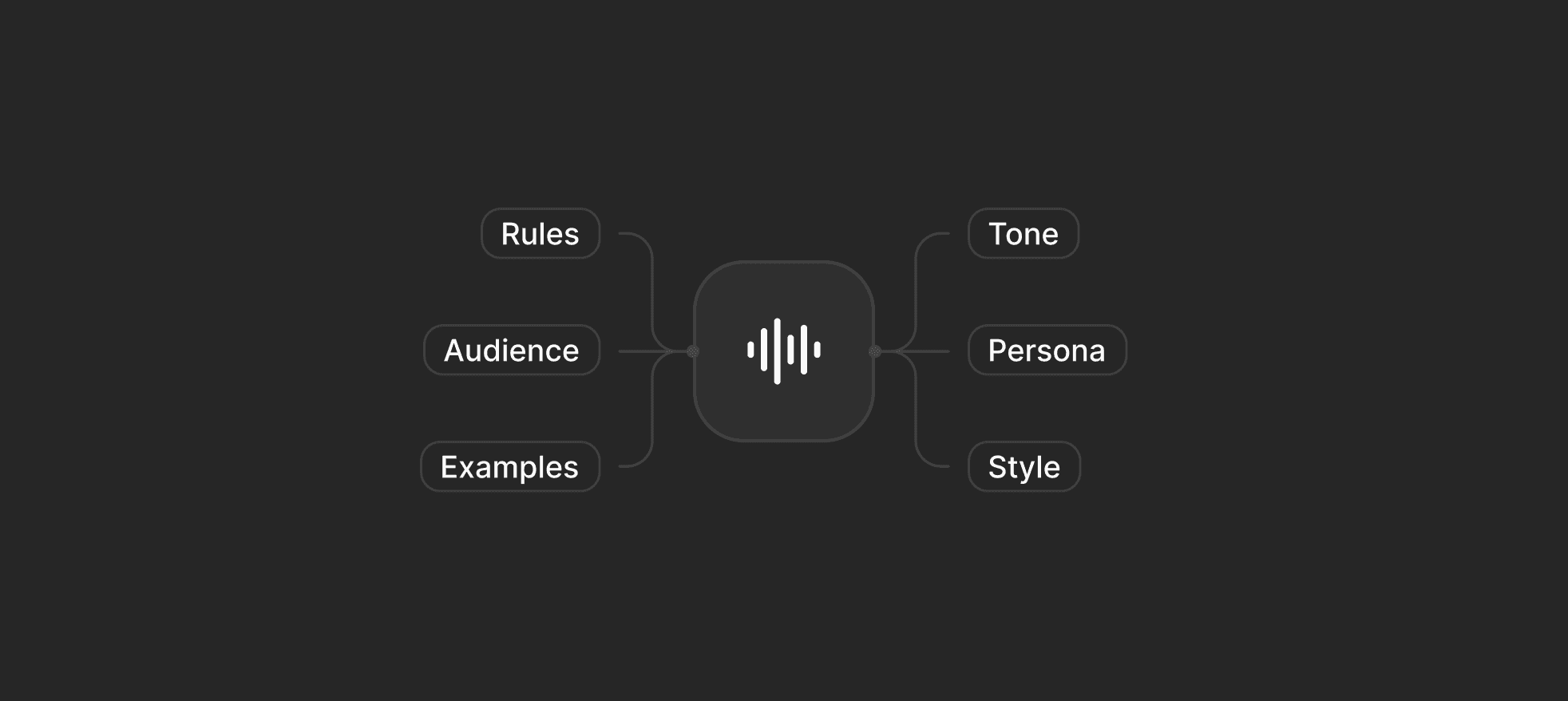
A complete brand voice has five components. Most marketing teams document one or two and call it done, which is why their voice docs fail to drive consistent output. Below is the full anatomy.
Personality and perspective
This is the voice itself. The three to five adjectives that describe how your brand sounds, plus the perspective you write from. Adjectives alone are not enough. "Confident" without an opposing trait reads as marketing-meeting boilerplate. The technique that works is the adjective-with-opposite pattern: pair each trait with what it is not. "Confident, but not arrogant. Direct, but not blunt. Warm, but not casual."
The opposite anchors the trait. It tells a writer where the line is.
Tone framework
Tone covers how voice modulates across situations. A working tone framework specifies at minimum: tone for product launches, tone for outages and incidents, tone for sales conversations, tone for support content and tone for community spaces. Each entry includes a sentence describing the register and a do-or-do-not example.
Without a tone framework, every writer guesses. The result is the same brand sounding playful in one channel and tense in another for no good reason.
Style rules
Style is the mechanical layer. The rules a copy editor enforces. A complete style section covers grammar (Oxford comma, sentence case), formatting (heading hierarchy, list style), phrasing (active voice, sentence length) and punctuation (em dash use, semicolons).
Style rules are unglamorous but they are what makes voice repeatable. A team without style rules ships content that drifts a little with every writer.
Terminology and glossary
Terminology defines the words your brand uses, the words you avoid and the way features and products are written. This includes preferred terms ("dashboard" not "control panel"), banned terms ("utilize" replaced by "use"), feature naming conventions, capitalization rules for product names and any industry words your audience expects.
Terminology is the component most often missing from a voice doc, and the one with the highest enforcement payoff. A consistent vocabulary is what makes a brand sound like a brand and not a thesaurus.
Audience definitions
Voice is not one-size-fits-all. Most B2B brands speak to multiple audiences. Engineers, executives, end users and partners each need a slightly different read of the same voice. A complete component defines each priority audience and notes how voice modulates for them. Engineers get more technical specificity. Executives get tighter abstractions. End users get fewer dependencies on internal jargon.
The audience layer is what makes voice usable across a real B2B funnel rather than just on the homepage.
Defining your voice
Defining a brand voice is not a workshop exercise. It is a four-step process that produces a documented, testable system. Skip any step and you will end up with a voice doc that does not enforce.
Audit existing content
Start by gathering 15–20 representative pieces of your existing content. Mix high-performing and average pieces, mix channels and mix writers. Read them in sequence and note: where do they sound the most like one brand? Where do they sound like three different brands stitched together? The audit gives you a baseline that is grounded in actual output, not aspiration.
The most useful question to ask during the audit: which two or three pieces best represent how the brand should sound at scale? Those become reference content for the rest of the process.
Pick three adjectives
Pick three adjectives that describe how the brand should sound. Three is a forcing function. Two is too narrow. Five becomes a list nobody can hold in their head. For each adjective, write the opposite trait that anchors it. "Direct, but not blunt." "Confident, but not arrogant." "Warm, but not casual."
If two of your adjectives mean roughly the same thing, you have not picked three. You have picked one with two synonyms. Find a third trait that adds new information.
Document the rules
Translate the personality into the four other components: tone framework, style rules, terminology and audience definitions. For each, write the rule and pair it with at least one do-or-do-not example. Examples carry more weight than rules. A writer reading "be direct" will interpret it three ways. A writer reading "Direct: 'Brivvy reduces editing time by 40%.' Not: 'In the modern marketing landscape, brands face increasing pressure to optimize content production at scale.'" will not.
Test against real content
The final step is the one most teams skip. Take five recent pieces of content the brand has published and rewrite them against the new voice. Then take five upcoming pieces and write them from scratch with the voice doc as the only guide. If the rewrites sound like the same brand, the voice doc works. If different writers produce noticeably different output, the doc has gaps and needs another pass.
This step is also where the voice doc earns its first round of edits. Most rules survive contact with real content. A few do not. The ones that fail get revised before the doc ships.
Brand voice guidelines
Brand voice guidelines are the document that captures everything from sections 4 and 5: the personality, the tone framework, the style rules, the terminology and the audience definitions. Done well, the doc is the single source of truth a writer reaches for before publishing anything.
Done badly, it is a 40-page Notion page nobody opens.
A working set of brand voice guidelines contains seven elements:
Personality summary. The three adjectives, their opposites and a one-paragraph narrative description of how the brand sounds.
Do-or-do-not examples. At least three for each adjective, drawn from real content where possible.
Tone-by-channel matrix. A short table specifying the tone register for each major channel and content type.
Style rules. Grammar, formatting and punctuation conventions a copy editor can enforce.
Terminology list. Preferred terms, banned terms, feature naming conventions and capitalization rules.
Audience definitions. Each priority audience plus a note on how voice modulates for them.
Sample edits. Three to five before-and-after edits showing how off-brand content gets corrected to on-brand.
Length is not the goal. A focused 10-page document with strong examples beats a 40-page document with weak ones every time. The test is whether a new contractor can read the doc on day one and produce on-brand content by day two.
Brand voice guidelines also need an enforcement layer. A document that lives in a folder is reference material. A document that runs at the point of writing, in the tools your team already uses, is governance. The shift from reference to governance is what separates teams that hold voice as content scales from teams that drift the moment headcount expands.
The next two sections cover what breaks down when guidelines stay reference-only, and what changes when AI gets folded into the picture.
Why voices fail
Most brand voice work fails for the same handful of reasons. The doc is not the problem. The system around the doc is.
The doc is not where writers work. A voice doc lives in Notion, Confluence or Google Drive. Writers work in Google Docs, your CMS, Slack, your help center editor and 10 other surfaces. Asking a writer to alt-tab to a 30-page reference every time they write a line is asking the doc to fail. Most rules go unread.
Onboarding is not real. When a new writer joins, the voice doc is rarely part of meaningful onboarding. It gets sent in a welcome email and never referenced again. By month three, the new hire has reverse-engineered an approximation of your voice from existing content, which means they have absorbed the inconsistencies along with the consistencies.
Freelancers and agencies bypass the system. External writers operate at speed. They skim the voice doc once at kickoff, then ignore it. The output reads competent but generic, and the editing burden falls on whoever is reviewing. Multiply this across a content team that uses three to five external writers and the editing layer becomes the bottleneck.
Distributed teams drift. Teams in different time zones build slightly different working norms. The same brand sounds slightly more formal from one office and slightly more casual from another. Without an enforcement layer, drift compounds quarter over quarter.
Reviewing voice is not the same as writing in it. Editing on-brand at the end of the pipeline is far more expensive than writing on-brand from the start. Most teams discover this only after a quarter of late-stage edits has eaten into roadmap time.
The common thread: brand voice fails when it is treated as a reference document instead of a system. The next section covers what changes when AI enters the picture, which makes the failure modes both worse and finally fixable.
AI brand voice
AI changed two things about brand voice. First, it made the inconsistency problem visible. Generic AI output published at scale exposes every gap in a voice doc within weeks. Second, it created a new way to enforce voice that did not exist before. The same technology that floods channels with off-brand content can be configured to flood them with on-brand content instead.
The shift you need to make is from prompting to training.
Prompting vs. training
Prompt-engineering "act like our brand" into ChatGPT or Claude every time you write produces uneven output and does not scale. The model has no persistent memory of your voice. Each session starts from scratch. A junior writer copying a prompt template gets close to your voice on a good day and not at all on a bad one. The same failure mode shows up at the team level once those prompts get saved into a shared library. For a deeper look, see prompt libraries versus voice infrastructure.
Training is the alternative. An AI brand voice tool ingests your voice doc, your style rules, your terminology and a corpus of on-brand content. It then enforces those constraints at every generation. The model is not pretending to be your brand. You configure it to write as your brand by default.
The difference shows up in editing time. Prompted output requires a heavy edit pass to bring on-brand. Trained output requires a light read.
What gets lost
Off-the-shelf AI tools optimize for fluency, not specificity. The output reads competent but generic. The tools sand off the signature phrases your team uses. They replace industry words with thesaurus alternatives. They flatten the structural rhythm that makes content feel like yours: short opening lines, deliberate punctuation, terminology consistency. AI tone of voice is the most visible failure mode: the same brand sounds clinical in one piece and chatty in the next, with no obvious reason.
Readers cannot always articulate what is missing. They feel it as a drop in trust. The content sounds like it could be from anywhere, which means it does not sound like it is from you.
On-brand AI generation
On-brand AI content generation is the practice of producing AI output that already conforms to your brand voice at the point of generation, not after. The category is sometimes called brand voice AI, sometimes called an on-brand AI content generator, but the architecture is the same. It requires three things: a documented voice, a tool that trains on it and an enforcement layer that runs at the writer's surface. The enforcement layer cannot be a separate review step.
This is the architecture that makes brand voice a system instead of a document. The next two sections cover what to look for in a tool that does this and how Brivvy implements it.
Tool selection criteria
Most marketing teams shopping for an AI brand voice tool overweight one criterion, output quality, and underweight everything else. Output quality matters. So do the four other criteria below.
Voice training depth. How much of your voice can the tool actually learn? Some tools accept a paragraph of guidelines and call it trained. Others ingest your full voice doc, your style rules, your terminology list and a corpus of on-brand content. The depth of training is what determines whether the output reads like your brand or a generic approximation.
Terminology enforcement. Can the tool prevent banned words and require preferred ones at the point of generation? Terminology rules are where most off-brand AI output goes wrong. A tool that only suggests terminology in a separate review pass has not solved the problem. A tool that enforces it during writing has.
Multi-writer governance. Brand voice is a team problem, not an individual one. A tool that lives in one writer's account leaves the rest of the team writing off-brand. Look for shared voices across the team, role-based permissions and audit trails for who used which voice.
Stack integration. A brand voice tool that requires writers to leave their existing tools is a tool that gets used by no one after week three. The integration points that matter are the editors writers actually use: Google Docs, your CMS, Slack and your help center editor.
Content type coverage. Some tools handle marketing copy well and product content poorly, or vice versa. The tool needs to produce on-brand output across the full range of content your team writes, not just the easy cases.
A tool that scores well on these five criteria becomes a brand voice software layer your whole team can rely on. A tool that scores well on only one becomes shelfware in a quarter.
How Brivvy enforces voice
Brivvy is built around the criteria above. Brand voice is the core problem, not a feature added on top of a generic AI writing tool. The differences are small in description and large in practice.
Brivvy trains on your full voice system: the personality and adjectives, the tone framework, the style rules, the terminology list and the audience definitions. The training is not a prompt. It is a configuration that holds across every generation, every writer and every content type. New content starts on-brand because Brivvy sets the model up to write that way by default.
Terminology enforcement runs at generation. Brivvy blocks banned words and applies preferred terms. Capitalization rules and feature naming conventions hold without a separate review pass. The terminology layer is the same one your style guide describes, only it runs as code instead of as a Notion page.
Brivvy includes multi-writer governance. Teams share voices rather than trapping them in one writer's account. A new contractor onboards by getting access to the right voice, not by reading a 30-page doc and guessing. Permissions and audit trails make it auditable.
The integration model is the second design call that separates Brivvy from prompt-based AI writing tools. Brivvy meets writers where they already work rather than asking them to switch tools. The voice runs in the editor your team uses, not in a separate generation surface. The same logic explains why a prompt library alone falls short: saving the prompt does not save the voice.
The result is an AI that writes in your brand voice, not a generic AI you have to wrestle into shape. The editing burden drops. The onboarding curve flattens. Voice consistency holds as the team scales.
Try Brivvy free and see what on-brand AI output reads like in your team's editors. For a side-by-side with the most common alternative, see Brivvy vs. Jasper.
Common mistakes
The most common brand voice mistakes follow a pattern. They are all easier to avoid than to fix.
Confusing voice with tone. Voice is the constant personality. Tone is situational. A doc that only specifies tone words has not defined a voice.
Writing the doc once and forgetting it. Your voice doc needs updates as the product, audience and market change. A doc unchanged for two years is reference, not governance.
No examples. Rules without examples are interpretable. Two of your writers will read "be direct" three different ways.
No enforcement layer. A voice doc that lives in Notion gets read once and ignored. Enforcement at the writer's surface is what makes it stick.
No audience tiers. If your B2B brand addresses engineers, executives and end users with the same voice, the content flattens into something useful to none of them.
Copying a competitor's voice. The point of brand voice is differentiation. A voice modeled on another brand makes you sound like a follower, not a category.
Brand voice in 2026
Brand voice work is changing fast in 2026. Three shifts are worth tracking.
Generic AI content is saturating channels. As more teams publish AI-assisted content at volume, the gap between on-brand and off-brand output gets sharper. Readers calibrate quickly. Content that sounds generic loses trust faster than it did two years ago. The brands that hold their voice through the saturation are the ones gaining share, not just keeping it.
Branded models and trained voice systems are replacing prompts. The first generation of AI writing tools assumed prompting was the interface. The second generation, which is where Brivvy sits, treats the brand voice itself as the configuration. Teams that adopt trained voice systems early build a moat around their content quality that prompted teams cannot match without rebuilding from scratch.
Style guides are turning into enforced systems. The old model was a Notion doc, a quarterly all-hands review and hope. The new model is a documented voice that runs as governance at the point of writing. The role of the marketing leader in 2026 is shifting from voice author to voice operator: defining the rules, then deploying them as a system rather than a reference.
FAQs
What is the difference between brand voice and tone?
How long should a brand voice document be?
Can AI learn a brand's voice?
How do you train an AI on your brand voice?
What is a brand voice generator?
How do you keep brand voice consistent across writers?