
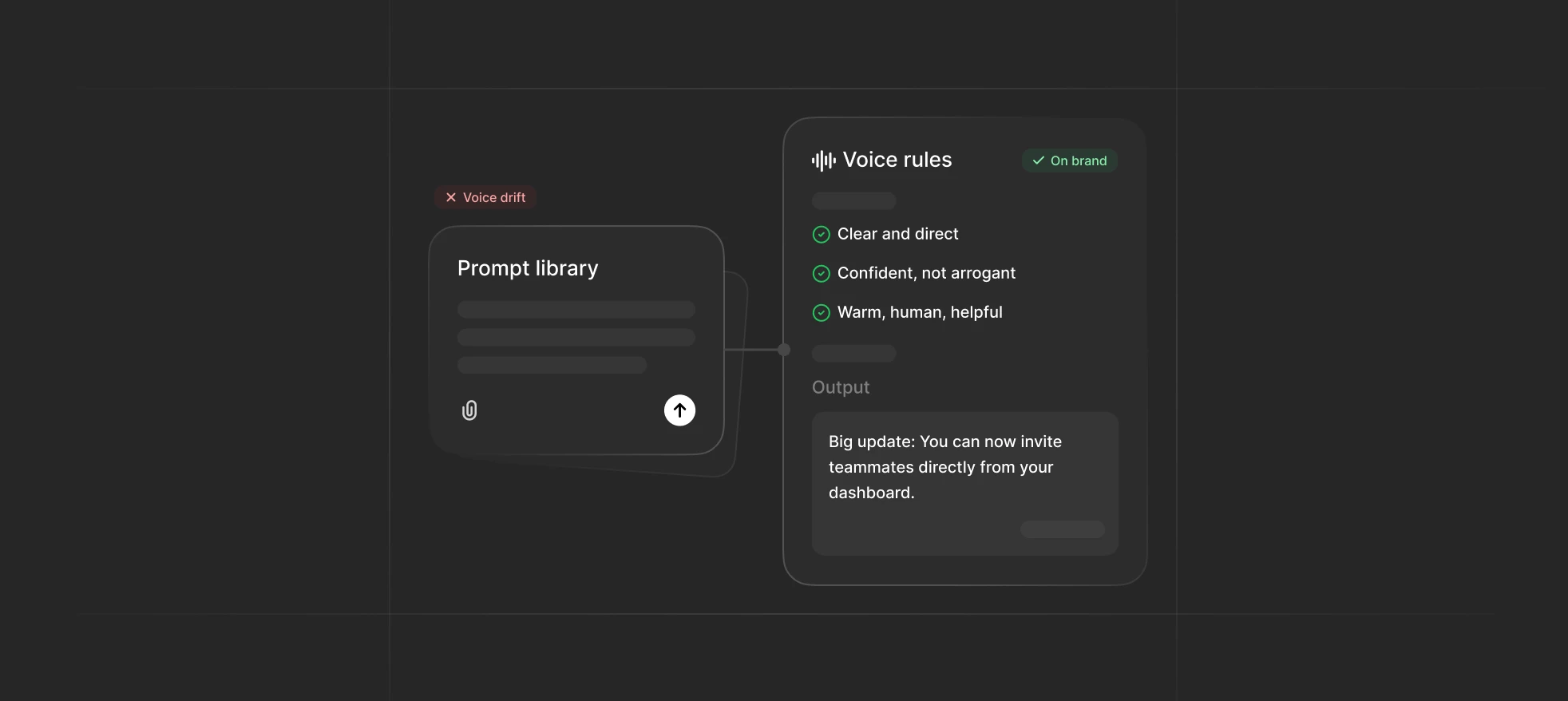
You saved a prompt last quarter that produced great copy. You ran the same prompt this week and the output drifted. The tone changed. The vocabulary changed. A reader cannot tell, but you can.
This is the story of every team running an AI prompt library at scale. The library does what it was built to do. It stores prompts, retrieves them and shares them across the team. What it does not do is enforce how the output sounds. A prompt library is a storage system. Brand voice is a governance problem. The two solve different jobs, and most teams discover the gap only after the brand has already drifted.
This piece explains what a prompt library actually does, where it breaks, why prompt versioning is a partial fix and what voice infrastructure adds on top.
The library problem
A prompt library is a saved collection of prompts your team uses to generate output from large language models. The format varies. A Notion page, a spreadsheet, a dedicated tool, a folder of text files. The function stays consistent across formats.
A prompt library performs three jobs:
Storage. Saved prompts in one location.
Retrieval. Findable when you need them.
Sharing. Available to teammates.
A prompt library does not perform a fourth job: enforcement. Nothing in the library checks that the output of a saved prompt still sounds like your brand. Nothing in the library tells you when a prompt has drifted from the rules it was supposed to follow. That gap is the rest of this piece.
Prompt management as a category begins where the library ends. The library is the artifact. Management is the system around it.
Where libraries break
Five failure modes show up in almost every team that scales a prompt library past 50 saved entries. The failure modes are not theoretical. They appear in the audit log of any team that has been running a library for six months or longer.
Copy-paste decay
A teammate copies a saved prompt, edits it for their task and runs it. The edited version produces good output. The teammate saves the new version on top of the old one, or saves it under a slightly different name. A week later, no one can tell which version was canonical. Every edit erodes the original intent of the prompt, and the decay compounds silently across hundreds of small changes.
The fork problem
Two teammates open the same prompt and modify it independently for two different uses. Both modifications survive. Now there are two competing versions of the same prompt, both labeled correctly, both producing different output. The fork problem is worse than copy-paste decay because both branches look legitimate.
The audit gap
A piece of copy goes live and lands wrong. The brand voice feels off. You want to trace it back to the prompt that produced it. The library cannot tell you which prompt was used, which version of that prompt or which teammate ran it. The audit chain breaks at the boundary between the library and the output.
Voice debt
A prompt library stores prompts. It does not store voice rules. Brand voice rules like "use the active voice," "avoid the word leverage," "open with a question if the post is for marketers" live somewhere else, usually in a style guide nobody reads. The library and the style guide drift out of sync, and the library wins by default, because the library is what people actually use. Every saved prompt that does not encode the current voice rules adds to your voice debt.
The handoff break
The person who built your prompt library leaves. The institutional knowledge of which prompts work, why they are structured the way they are and what edge cases they handle leaves with them. The next teammate inherits a folder of text and no operating manual.
The case for versioning
Prompt versioning is the practice of treating each prompt as a tracked artifact with a version history, an owner and a change log. The concept comes from software engineering, where version control is standard practice for code.
A small ecosystem of LLMOps tools has built prompt versioning for engineers. LaunchDarkly, Braintrust, Langfuse and PromptLayer all offer version control for prompts used in production AI applications. The framing in these tools is technical. The unit of governance is the model output, the audience is engineers, the failure mode is broken inference.
That framing is incomplete for marketing teams. Engineers care about whether a versioned prompt still produces a valid response. Marketers care about whether a versioned prompt still produces on-brand copy. Those are different tests, and the second one is harder, because brand drift is invisible to a model. A prompt that produces grammatically correct output that sounds nothing like your brand will pass every engineering check.
When the unit of governance is voice rather than output, prompt versioning becomes prompt version control for brand: rules are written down, versioned and queryable, and they apply across every prompt your team runs. That is the bridge from prompt management as a developer concern to voice infrastructure as a brand concern.
Templates fall short
A prompt template is a reusable scaffolding for a class of prompts. Templates are useful. They solve fork drift by giving everyone the same starting point. They solve syntax errors by enforcing structure. They do not solve voice.
The reason is simple: a template specifies the shape of the prompt, not the rules of the output. A template that says "write a friendly email to a new customer" produces 50 different definitions of friendly across 50 teammates. Some will be casual, some will be warm, some will be effusive, some will be clipped. All of them are friendly. None of them sound like your brand.
Prompt templates are necessary infrastructure. They are not sufficient infrastructure. They solve the structural problem and leave the voice problem untouched.
Inside Claude's library
Anthropic publishes a claude prompt library on its developer platform. The library contains worked examples of effective prompts for common tasks: code review, customer feedback summarization, structured data extraction, content rewriting. Each entry shows a system prompt, a user prompt and the expected output.
The library is useful. The examples are well-constructed, the structures are reusable and the patterns transfer to most large language models, not just Claude. A team building its own internal library will find ideas worth borrowing.
What the claude prompt library does not do, by design, is enforce your brand voice. It is a teaching resource, not a governance system. Anthropic cannot encode your voice rules, because the rules are yours, not theirs. A library is a starting point. It tells you what good prompts look like. It does not make every prompt your team writes sound like the same brand.
From storage to governance
Voice infrastructure is the system of documents, tools and processes that codify how a brand sounds and make it reusable across teams and AI models. It turns abstract voice principles into operational assets like voice charts, lexicons and style guides.
The three-layer framework that voice infrastructure operates on:
Foundation. Brand voice principles like "confident, not arrogant" or "warm but precise."
Codification. A voice chart, brand lexicon and style guide that translate those principles into specific word choices.
Activation. Templates, prompts and AI voice models that apply the rules at the point of writing.
A prompt library sits inside the Activation layer. It is one of the tools that the Foundation and Codification layers feed. The reason libraries fail in isolation is that they are operating without the upper two layers, so the rules they are supposed to apply do not exist as queryable assets. A team running a prompt library without voice infrastructure is running the activation layer of a system whose other two layers live in someone's head.
Voice infrastructure, sometimes called voice ops or the voice stack, adds three things on top of a library: enforcement, audit and evolution. Enforcement means voice rules apply automatically to any output, regardless of which prompt or which teammate. Audit means you can trace any piece of copy back to the rules it was produced under. Evolution means the rules can be versioned, updated and propagated through the system without rewriting every prompt downstream.
Brivvy is one example of voice infrastructure built for marketing teams. Mailchimp's public Voice and Tone guide is an earlier example of the same idea applied to a single brand, from the era before AI writing tools made the problem urgent for everyone else.
Frequently asked questions
What is a prompt library?
What is the difference between a prompt library and prompt management?
What is prompt versioning?
Is Claude's prompt library free?
Do you need a prompt library if you have brand voice rules?
When does a prompt library stop being enough?
What now
The next step is to audit your current prompt library against the five failure modes above. Count the saved prompts. Count the forks. Try to trace one recent piece of copy back to the prompt that produced it. If any of those steps stall, you are running an activation layer without the foundation and codification it requires. The fix is not a better library. The fix is the system around it.